My father was a high school art teacher. In the 70’s he took leave to Mexico to get his Masters degree at the Instituto Allende in San Miguel de Allende. It was a different place then. No doubt. Like everywhere.
Some days I got to visit my father’s studio, and wander the Insituto. The smell of linseed oil lingered the hallways of the former convent turned art school. The students, the grown ups, argued about color like the world depended on solving it’s mysteries. Friendships were probably ruined over the color green or violet. They were serious. This was serious stuff.
I remember one of my father’s professors one day took his brush and drew a big red ‘X’ over his painting, told him to start over. He returned that day sullen. But a lesson learned.
There were nights in the living room, the grown ups gathered and drew models and discussed classes, art, and which professor was a better painter.
Evenings were warm. Giant bugs covered the walls outside the apartments. There was a pool but no one used it because someone put a big nasty turtle in it. People said it would give you polio. To this day I think turtles can give you polio. Inside there was camaraderie, vehement discussions, cycles of death and life on a single sheet of paper.
This was a time that imprinted itself. This was the romantic age. A community of artists. It’s what I have sought… in a way… since. It’s an older time.
On the weekends the Masters students of the Instituto Allende ran a sort of day school. The kids could come and make art all day. I loved this. I drew at first. And then I hammered together a giant sculpture of abandoned vegetable crates. The grown ups hadn’t been watching, maybe they were having drinks, but they didn’t realize how large it had gotten. A few days later the school made me take it away. My three friends dragged this monstrosity through the narrow streets not knowing where we were going to put it. A police inspector finally stopped us and told us to get it off the street in five minutes or us 8 yr olds were going to jail. Luckily one of the mothers drove by and we put it on her car and made our get away.
I then built wooden ‘Star Trek phasers’ which my friends and I would wield as we explored the city after school. Back then we were out until dinner and traveled far beyond where our parent’s would have felt assured for our safety. The only border we recognized was the hills of Tres Cruces. Rumor had it that witches lived there and they ate children. This was our Romulan Nuetral Zone.
Speaking of school. I went to a two room bilingual school then, run by an incredible American educator, Augusta Irving. She had settled in San Miguel in the 1950’s. She was dedicated and innovative. A gem really, and Undiscovered. I came across this piece that describes her well…
PROFILE of AUGUSTA IRVING 1908-1998
LANGUAGE AND THE LADY
by Sylvia Berek Rosenthal
She was small, almost birdlike in appearance and movement. Always dressed for an occasion and carefully made up. She always knew exactly where she was going and what she wanted to say. And she said it almost too directly.
You knew her. She was Augusta Irving and for many years she wrote that regular lead article in Atencion, "Worth Repeating".
In order to do this, Augusta read every Spanish diario available in San Miguel. She culled those articles she felt were of interest and importance to gringos here. She then translated those pieces into her own personalized, very recognizable English prose. Augusta never used a common two syllable word when an uncommon four syllable word would do. Her readers read her material as much for the style of her writing as for the news it provided. Mess with her prose at your peril. You could as lief try to correct Ring Lardner or William Shakespeare.
In her other life, back in New York City, Augusta sent a first short story to the New Yorker. It was accepted. Do you know of anyone else whose first short story was accepted by the New Yorker? Accepted and then published. And according to Augusta, they edited out "Augusta" and made it into a "New Yorker" story. She never sent them another thing.
In 1953 Augusta came to San Miguel, looked around, learned the language, probably sowed a few wild oats and decided to make her home in what was then a very small town. First order of business had to be a way to earn a living. She totted up her skills, found what she felt was a need in this community and opened the first bilingual school here.
It is hard now to describe the uniqueness of such an institution when it opened then. It was probably the first school that truly served Mexican and foreign students. And being the first was far from its only virtue. Language always was the soul of life for Augusta. She developed a program whose goal was to make her students fluent and literate in both Spanish and English. To know how well she succeeded just ask any young folk who are former students. They'll tell you in clear and accurate English and Spanish.
Augusta knew that to teach one must continue to learn. As long as she ran her school she maintained contact with educational publishing houses in the States and in Mexico City. She was constantly searching for better and more interesting ways to share knowledge with her students. That did not mean she jumped on the bandwagon of every new educational fad that came into being. She was always as selective in her choice of educational materials for her school as she was in selection of written material for her own education and edification.
The New Yorker and The New York Times Book Review always counted Augusta among their subscribers. She was aware of what was being published and selectively ordered those books she deemed worthy. Senora Irving was also an inveterate user of the Biblioteca which she helped found. When a book was not up to her standards, she was quite critical and had been heard to comment, "Well the content is worth reading but, my dear, the writing is an abomination."
Augusta Irving had one other important skill that is totally irrelevant to her lifelong devotion to language. She made the very best margarita in all of San Miguel.
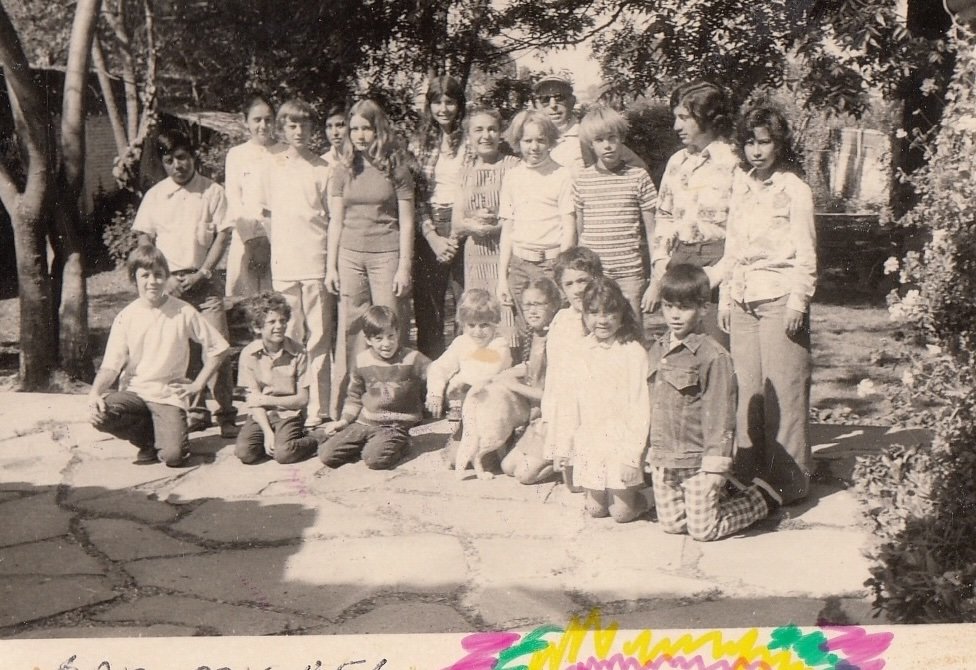
Class photo, 1976. Augusta (middle) and her assistant teachers and students.